











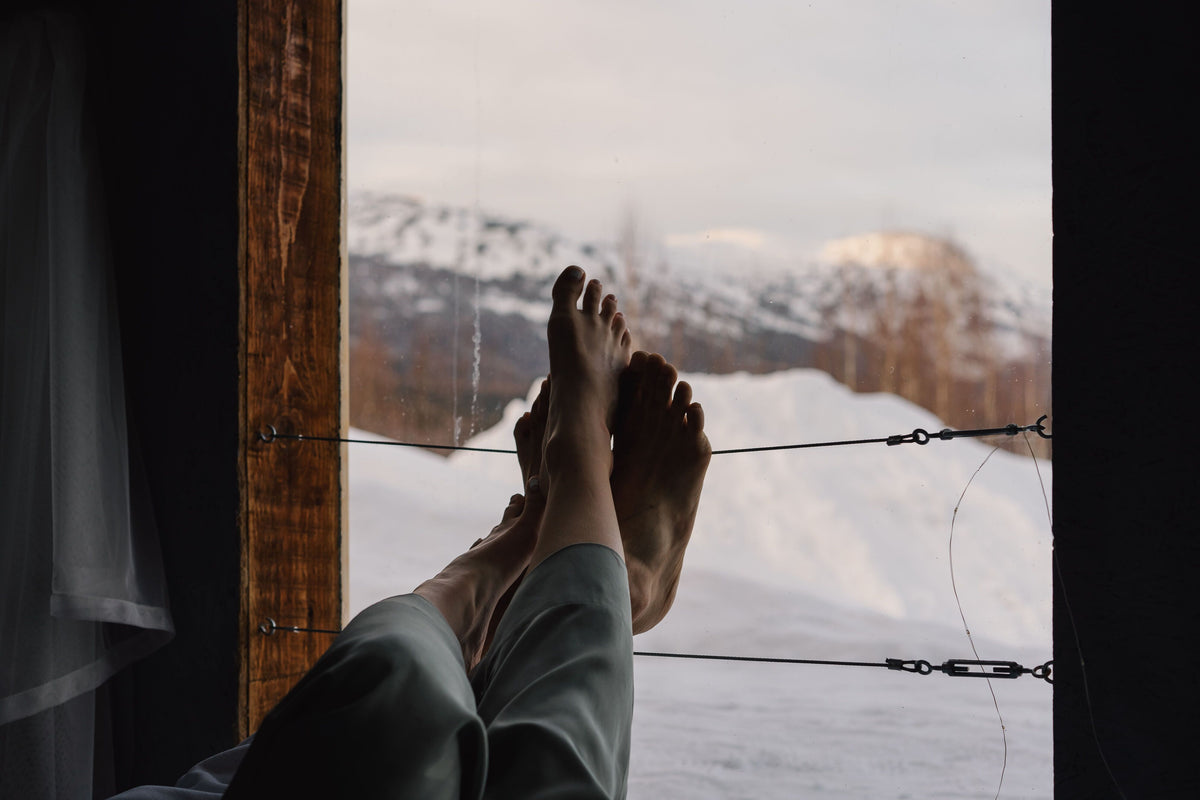
Cold feet indoors are oddly resistant to the obvious fix. You turn the heating up, the room gets warm, and your feet stay cold anyway. That is because the room temperature is only part of what is happening at floor level, and because feet lose heat in two different ways that need two different answers. This guide covers what is actually going on and how to fix it properly rather than by turning the thermostat up another degree.

Why do your feet get cold indoors even with the heating on?
Two things are happening at once. Your floor conducts heat away from your feet on direct contact, which is far more efficient than air cooling them, and your body restricts blood flow to your extremities in cool conditions to protect your core temperature.
Conduction is the part people underestimate. Tile, laminate, vinyl and concrete all pull heat out of your feet quickly because they are dense and they stay cooler than the air above them. A room can feel comfortable at chest height while the floor remains noticeably cooler, and your feet are the only part of you touching it.
The circulation side then makes it self-sustaining. Once your body narrows the blood vessels in your hands and feet, warming the room does not reverse it quickly, because your body is deliberately sending warmth elsewhere. This is why your feet may remain cold even after the room has warmed up, and why insulating your feet directly can be more practical than relying only on room heating.

Do slippers or socks work better for cold feet?
They solve different halves of the problem, which is why people who own one and still have cold feet usually need the other rather than a better version of what they have.
A slipper is a barrier. Its job is to stop the floor conducting heat out of your foot, and the sole does most of that work. A thin slipper with a hard sole blocks very little.
A sock is insulation. Its job is to trap a layer of warm air around the foot itself and, if it is long enough, around the ankle where blood vessels run close to the surface. A sock does nothing about a cold floor if you walk on it directly.
Put plainly: the slipper stops heat leaving downwards, the sock keeps heat around the foot. Neither substitutes for the other, and the combination is noticeably warmer than either alone.

What makes a slipper actually warm?
Cushioned thickness underfoot, full coverage over the top of the foot, and a sole that separates you from the floor. Thickness is doing two jobs here, insulating and also lifting your foot away from the cold surface, which is why a plush cushioned construction beats a thin flat one even when both feel soft in the hand.
The Slumblr® Plush Winter Moon Slippers are built around that cushioned thickness. The rounded moon-style silhouette gives a deep, enveloping shape rather than a flat footbed, made with fluffy plush fabric over cushioned construction, so there is real material between your foot and the floor rather than a token layer.
The slip-on design matters more than it sounds for something you put on and take off repeatedly through an evening. Anything fiddly gets skipped, and a slipper by the door that never goes on is not warming anybody.
If your cold feet are mainly a getting-out-of-the-house problem rather than an at-home one, our cold-weather comfort kit covers the outdoor side of the same question.

Why do socks still matter if you are wearing slippers?
Because a slipper covers the sole and the top of your foot and stops there. Your ankle and lower calf are left bare, and that is exactly where blood vessels sit close to the surface. Cooling the blood passing through there cools what reaches your toes.
Length is therefore the feature to look for, not just thickness. A longer sock provides additional coverage around the ankle and lower calf, helping retain warmth across a larger area.
The Slumblr® Women's Cashmere Wool Socks are built for that. They are a long thick-knit design in a wool and cashmere blend, which is the useful combination: wool insulates while still handling moisture, so your feet stay warm without getting clammy over a long evening, and cashmere adds softness against the skin that pure wool can lack.
They come as two pairs, and you choose both colours separately from black, purple, pink, grey, white and light brown. Two pairs is the practical minimum for something you will want on most evenings, because one pair means going without on wash day.
They also work under boots rather than only at home, so they are not single-purpose.

Should you wear socks and slippers together?
For cold floors, wearing socks and slippers together is a practical way to combine insulation with protection from the cold surface. The sock insulates the foot and ankle, the slipper blocks the floor. Each one closes a gap the other leaves open.
There is one thing to get right. Buy the slipper with the sock in mind rather than buying both to fit exactly. A thick knit sock takes up real space, and a slipper sized to a bare foot will feel tight over one, which compresses the sock, flattens the air it was trapping and makes both less warm. If you are between sizes, size up.
Set them up where you will actually use them. Slippers next to the bed rather than by the front door, so your feet never touch a cold floor first thing. Socks on before you get out of bed rather than after. Our cozy night in checklist covers the rest of the evening setup.

Can cold feet affect how well you sleep?
There is a reason this belongs on a sleep site. To fall asleep, your body lowers its core temperature, and it does that largely by releasing heat through the hands and feet. That process works poorly when your extremities are cold and the blood vessels there are constricted.
The practical consequence is counterintuitive: warming your feet before bed can help you fall asleep faster, even though the overall goal is for your body to cool down. Warm feet open the pathway that lets heat escape.
That is why socks at bedtime help some people considerably. If you find socks in bed uncomfortable, warming your feet beforehand and then taking them off works on the same principle.

When are cold feet worth mentioning to a doctor?
Cold feet in winter are usually ordinary and resolve once you warm up. A few patterns are worth raising with a healthcare professional rather than solving with socks.
Fingers or toes that change colour, going white or blue and then red as they warm, is a specific pattern worth getting checked. So is numbness or pain rather than simple cold, cold that is consistently worse on one side than the other, or a new and persistent sensitivity to cold that is out of proportion to the weather, particularly alongside fatigue or other changes.
If you have reduced sensation in your feet for any reason, take particular care with direct heat sources such as hot water bottles or heat packs, since it is possible to burn skin you cannot feel. Insulation is the safer approach in that situation, and worth discussing with your doctor.

FAQ
Why are my feet always cold even in a warm room?
Floors conduct heat away from your feet on contact far faster than air cools them, and your body restricts blood flow to the extremities when it is cool. Both mean your feet can stay cold in a room that reads a comfortable temperature at chest height.
Are slippers or socks better for cold feet?
They do different jobs. A slipper blocks the cold floor through its sole; a sock insulates the foot and ankle. For cold hard floors the combination works noticeably better than either on its own.
What makes a slipper warm?
Cushioned thickness underfoot, which both insulates and lifts your foot off the cold surface, plus coverage over the top of the foot. The Slumblr® Plush Winter Moon Slippers use a deep rounded shape with plush fabric over cushioned construction rather than a thin flat footbed.
Are wool socks better than cotton for cold feet?
Generally yes. Wool insulates while managing moisture, whereas cotton holds damp against the skin and feels cold once it does. The Slumblr® Women's Cashmere Wool Socks use a wool and cashmere blend in a long thick-knit length that covers the ankle.
Does wearing socks help you fall asleep?
For many it does. Your body lowers its core temperature before sleep by releasing heat through the hands and feet, and that works poorly if your feet are cold and circulation is constricted. Warming your feet first can shorten how long it takes to drop off.
Should I size up slippers if I wear thick socks?
Yes. A thick knit sock takes up real space, and a slipper sized to a bare foot will compress it, flattening the air the sock was trapping. If you are between sizes, choose the larger one.




Leave a comment
This site is protected by hCaptcha and the hCaptcha Privacy Policy and Terms of Service apply.