



























Most people board a long-haul flight hoping to sleep and arrive feeling rested. Most people fail. They fold a jacket against the window, slump sideways, and wake up two hours later with a stiff neck and sore legs. The problem isn't that sleeping on a plane is impossible. It's that the standard approach ignores three distinct comfort problems that need three different solutions: head and neck support, small-space cushioning, and leg fatigue. This guide covers all three.

Why is it so hard to sleep on a long-haul flight?
Sleeping on a plane is difficult because economy seating creates three simultaneous discomforts that are hard to solve at once. The head has no stable resting point and drops forward the moment you fall asleep. The seat is hard and narrow, leaving little surface for body positioning. And legs hang unsupported for hours, which restricts circulation and creates the heaviness and aching that make it impossible to stay comfortable.
A standard U-shaped neck pillow solves only the first problem partially, and even then only when the head falls backward, which is not the direction most seated heads actually fall. Solving all three problems requires thinking about flight comfort as a system rather than a single accessory.
What is the best travel pillow for sleeping upright on a plane?
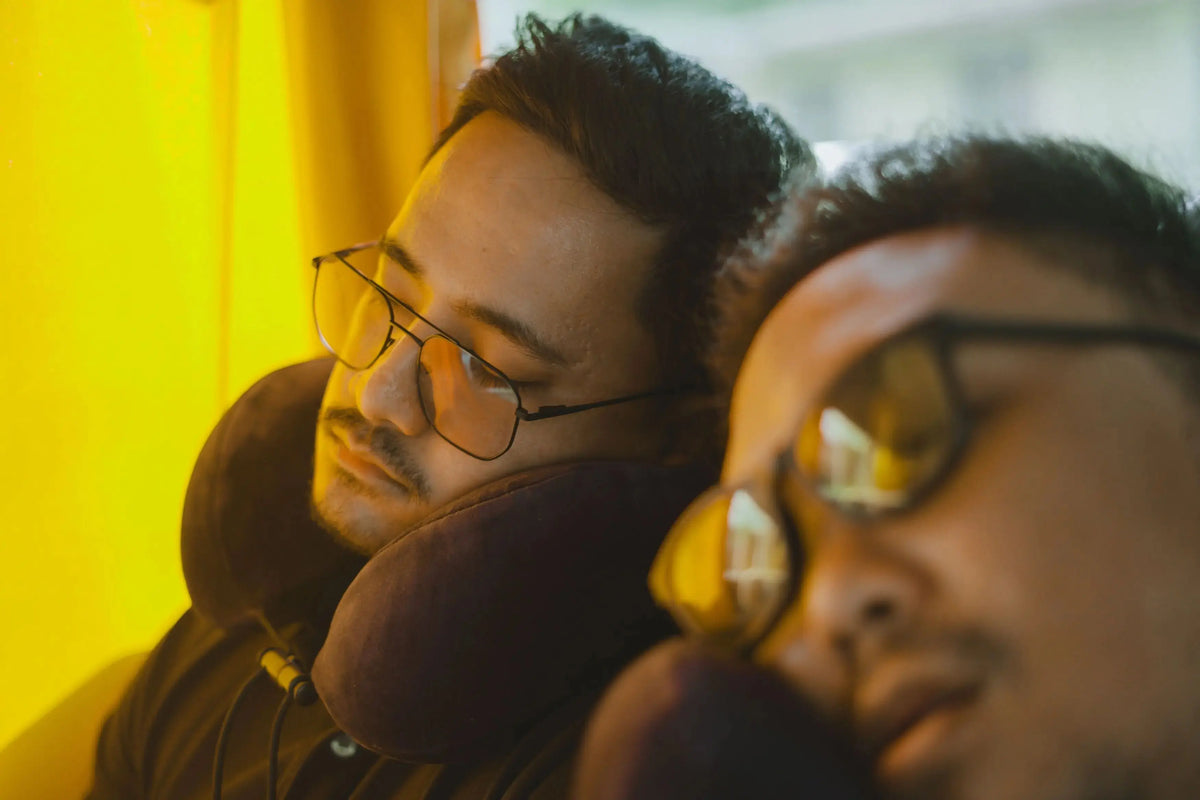
The best travel pillow for upright sleep on a plane supports the head in the direction it actually falls during seated rest, which is forward and downward, not backward. A pillow designed for this forward lean intercepts the head before it drops into an uncomfortable position, rather than trying to hold it up from behind.
The Slumblr® Travel Pillow Inflatable Headrest is built around this principle. Its patented 45-degree forward-lean angle positions the support surface exactly where the head naturally drops during seated sleep, reducing the cervical pressure that causes neck stiffness on long flights. The Big Air valve system inflates the pillow quickly and deflates it fast for packing, and at 0.78 lbs fully deflated it adds no meaningful weight to a carry-on. Available in Grey, Blue, and Black, it includes a drawstring travel bag for storage. The soft-touch fabric surface sits comfortably against the skin for extended contact during sleep. Unlike fixed-shape neck pillows, the inflatable design lets you adjust the firmness to your preference by inflating more or less before you settle in.

How do small pillows help during long flights?
Small compact pillows fill gaps in seating comfort that a neck pillow cannot. They add cushioning between the lower back and seat, soften the hard armrest surface for a resting arm, support the head against a window, or provide extra padding under a sleeping child. The versatility of a compact pillow means it earns its carry-on space across multiple uses in a single flight.
The Slumblr® Mini Travel Comfort Pillow addresses this need as a two-piece set sized at 8x12 inches (20x30cm), which fits into most seatback pockets or bag side pockets without taking up significant space. The smooth cotton fabric with balanced soft fill maintains shape through repeated repositioning, which matters on a flight where you adjust your position frequently. The breathable cotton exterior stays comfortable against skin during extended contact. The set comes in six color options including Beige, Black, Grey, Coffee, Pink, and Red, and both pieces are machine washable and quick-drying. Having two pillows lets you use one for lumbar support and one for arm or head cushioning simultaneously, which a single pillow cannot do.

What causes leg fatigue on long flights and how do you prevent it?
Leg fatigue on long flights comes from sustained static positioning with no elevation. When your feet rest flat on the floor for hours, the lack of elevation allows fluid to pool in the lower legs and feet, and the constant pressure against the seat edge restricts blood flow through the thighs. The result is the heavy, aching sensation that sets in after a few hours and makes it impossible to find a comfortable rest position.
Elevating the feet even slightly during flight changes the fluid dynamics in the lower legs and reduces the pressure on the backs of the thighs. The Slumblr® Airplane Foot Hammock Travel Comfort Accessory attaches to the tray table with adjustable straps, creating a suspended platform that elevates the feet off the floor without requiring any changes to the seat or extra space. The adjustable strap design lets you customize the height and angle for different seat configurations and leg lengths. A padded fabric base provides a supportive surface rather than a hard one, and the whole unit folds flat into carry-on luggage when not in use. It works on planes, trains, buses, and long car journeys where the same leg fatigue problem applies.

How do you set up a long-haul flight sleep system that actually works?
A practical long-haul flight sleep setup uses each product to address a different layer of the comfort problem rather than relying on any single item.
Start with the foot hammock. Attach it to the tray table before takeoff, while there is still room to maneuver under the seat. Setting it up early means your legs are elevated from the start of the flight rather than after fatigue has already set in.
Position the mini travel pillows next. One behind the lower back fills the gap between the lumbar spine and the seat, which most aircraft seats do not support adequately. The second can rest on an armrest, reduce contact pressure against the window, or be set aside for use when repositioning later.
Inflate the travel headrest to your preferred firmness and position it on the tray table or on the seatback tray in front of you before you plan to sleep. The 45-degree forward angle means you can rest your forehead and chin against it in a natural forward-lean position, which is the posture most seated sleepers fall into naturally. Adjust the inflation level slightly lower than maximum to allow the surface to conform more closely to the face and arms.
Used together, this three-product approach addresses elevation, cushioning, and head support simultaneously. Each product weighs under a pound and all three fit together in a carry-on side pocket.

Are there things you can do beyond accessories to sleep better on a plane?
Yes. Flight accessories address the physical discomfort side of in-flight sleep, but behavioral preparation matters just as much. Adjusting your schedule toward the destination time zone in the days before a long flight helps your body start adapting before you board. Avoiding alcohol during the flight improves sleep quality significantly, since alcohol reduces REM sleep and causes more fragmented rest even when it makes falling asleep feel easier.
Staying hydrated counters the low cabin humidity that increases fatigue and headaches on long flights. Wearing comfortable, loose clothing removes one more source of physical restriction during sleep. And booking a window seat gives you a stable surface to lean against and removes the disruption of other passengers needing to pass you during the flight.
The accessories handle what you cannot control. Your choices before and during the flight handle the rest.

FAQ
Does a travel pillow actually make a difference on long flights?
Yes, when it addresses the correct problem. Most neck pain from flights comes from the head dropping forward during sleep, not from lateral neck strain. A pillow designed for forward-lean support, like the Slumblr® Travel Pillow Inflatable Headrest, intercepts that forward drop and reduces the cervical pressure that causes stiffness after long flights.
How does a foot hammock attach to an airplane seat?
The Slumblr® Airplane Foot Hammock attaches with adjustable straps to the tray table in front of you. The straps loop around the table and lock at your preferred height, suspending the padded platform below. Most tray tables on commercial aircraft are compatible with this attachment method.
Can I bring a foot hammock and travel pillow in carry-on luggage?
Yes. The Slumblr® Airplane Foot Hammock folds compactly for carry-on storage. The Travel Pillow Inflatable Headrest deflates flat and comes with a drawstring storage bag. The Mini Travel Comfort Pillows at 8x12 inches fit in a bag side pocket. All three items together add under two pounds to your carry-on weight.
What is the difference between an inflatable travel pillow and a standard foam neck pillow?
A foam neck pillow has a fixed shape that does not compress for packing and cannot be adjusted for firmness. An inflatable travel pillow packs flat and lets you control the support level by inflating more or less. The Slumblr® Travel Pillow Inflatable Headrest also uses a 45-degree forward-lean design rather than a traditional backward-support U-shape, which better matches how seated heads actually fall during sleep.
Do mini travel pillows help with back pain on flights?
Yes. Positioning a small pillow behind the lower back fills the lumbar gap that most aircraft seats leave unsupported, which reduces the lower back tension that builds over several hours of sitting. The Slumblr® Mini Travel Comfort Pillow set lets you use one for lumbar support and one for other positioning needs simultaneously.
Is a foot hammock useful on trains and buses as well as flights?
Yes. The Slumblr® Airplane Foot Hammock works on any seat with a forward tray or surface at the right height for strap attachment, including many train seats and some bus configurations. The adjustable strap design accommodates different seat and table heights across transport types.



Leave a comment
This site is protected by hCaptcha and the hCaptcha Privacy Policy and Terms of Service apply.